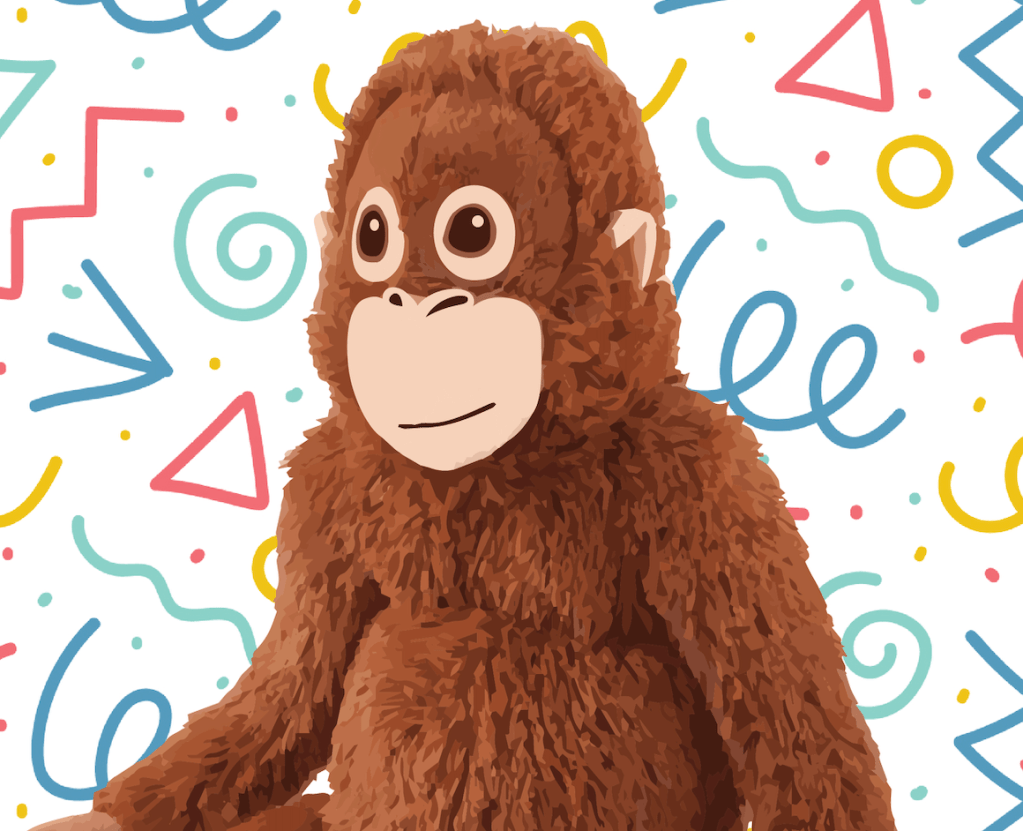
Hello! My name is monkey.
Monkey is my toy, and I would say he is a very important part of my personality – so it felt right to include him in my blog. I have kept the fact that I have a soft toy called monkey very private, due to a fear of embarrassment. I have had many people ask me, in judgemental tones, ‘why do you always have that monkey with you?’ or ‘what’s your obsession with monkeys?’ Though I imagine they do not mean to offend me, when someone judges monkey, I feel like they are judging me.
Describing monkey’s role in my life will uncover a lot of different aspects of my autism, which I used to be reluctant to discuss. Now, however, I believe that by being open about my monkey, I can also be open about my experiences as an autistic person.
I got monkey right around the time I was diagnosed with autism, and he quickly got accepted into the family. He gets his own Christmas presents under the tree. He flew halfway around the world, to Australia, with us. He comes to football games with me, and he even has his own strip. Last Halloween monkey and I dressed up as Mario and Luigi.
Monkey has also started a lot of conversations. Many people have asked about him and complimented him. I once even met a couple who had their own version of a monkey, and we were very excited to share our monkey love. His charm makes everybody love him.
Unfortunately, it’s not always fun and games. At the time I got monkey, I was going through a particularly tough time, and really struggling with my mental health. During my time at mainstream school, I regularly experienced ‘After School Restraint Collapse.’ This is a reaction that autistic pupils experience where they are trying so hard to keep themselves together during the day, that when they come home, they ‘collapse.’ This could be outbursts of anger, or a shutdown. This is often likened to shaking a bottle of fizzy juice. If you imagine the challenges an autistic pupil faces throughout the day – such as masking around their peers or sensory overload – being the bottle being shook, the pressure inside builds up so much that when you get home, you have no option but to release it all. For me, I used to have big meltdowns where I just cried and cried. Monkey was always there, on my bed, being hugged and soaking up my tears.
Though I have now left school, and my meltdowns are a lot less frequent, monkey still helps to keep me calm. I have such positive thoughts and memories around monkey, that when I’m struggling, just looking at him can cheer me up. Sometimes, when I’m having a tricky moment, it can be hard to think of something positive; having a physical item to look at and feel helps me massively.
Monkey also helps ground me. As well as my big monkey, I also have a smaller, pocket-sized monkey that fits discreetly in my pocket, and he’s perfect for going out and about, or at more formal events. Whenever I get nervous or overwhelmed, especially if I’m out by myself, I find it helpful to squeeze it and remind myself to take a deep breath.
Though monkey is only a soft toy, he has become a lifeline to me.
On a wider note, I think there is something to be said about the relation between autism and comfort items. I have found that a lot of autistic people have comfort items, such as cuddly toys. Perhaps it is because we feel less inclined to let go of habits from childhood because we’ve supposedly ‘outgrown’ them. Or perhaps it’s because daily life with autism can cause a lot of anxiety, having a comfort item is a necessity. Whatever the reason, I think it very important that people are accepting of this habit and don’t judge people for it. It is doing no harm to anybody and will be helping the autistic individual massively.


 I am autistic