
With universities across the country starting up again, I thought it would be a good time to talk about one of the scariest parts of university (for me): living away from home!
Starting university is a period of change, and for autistic students it can be a challenge. Managing living away from home – often for the first time – alongside all the social, academic and wellbeing pressure of university can easily be overwhelming. I want to share my experience of moving out for the first time, and how I dealt with the anxiety and upheaval that comes along with it.
Moving out of home, for me, started long before September. I had, alongside my parents, put in a lot of effort to get to this point, and I was really hoping it would help (it did!). For me, it was a lesson that you can never be too prepared. Here are a couple of practical steps I took before the big day:
At home, I started making my own meals, cleaning my dishes, doing my laundry, and practicing general household chores. This helped me to iron out – no pun intended – the problems that might have arose when I lived alone. I am thankful I spent time making mistakes – dropping and smashing glasses, and ruining my clothes in the washing machine with a red sock – before I was out on my own. It was a lot easier to prepare for student accommodation having learnt most of the lessons I needed with my parents there to support me.
Outside of the house, I then spent time travelling from my home city to my university. This helped me to familiarise myself with my surroundings, so I knew the train journey and the key points of town. During my first week at university, there was so much going on that I felt relieved that getting lost was not something I had to worry about. It was also reassuring to me, that if it ever got too much, the buses and trains home were on a tried and tested route.
Another thing which I was really grateful to get the opportunity to try, was to stay in my student accommodation over summer. My university lets out their rooms in the holidays, and I managed to spend a week in a flat similar to the one I would move into. Again, this helped me to adjust to what it might be like, without having to get to lectures or welcome events like I did in my first week. I spent time wandering around campus, exploring my new city, and watching lots of Netflix! I found this time helpful to adjust to the smaller changes that I hadn’t considered, such as waking up and going to bed with no reminders, or how I’d like to communicate with my parents. Whilst they might not be things that my non-autistic peers would consider when moving to university, it helped me to process these changes on a practice run. Even if you can’t stay at the university over summer, I would recommend staying at a friend or family’s house if you can. It really helps to tackle the challenge of moving away from home, in smaller, more manageable chunks.
After working on your own independence, there are also a lot of logistics to tackle. If you think that student accommodation will matter to your comfort and progress, I would encourage you to incorporate it into your decision making. Tour accommodation on open days or do your research online. My university offered studio flats, meaning I had one room to myself, including my bed, desk, kitchen and bathroom. This was important to me and so played a big part in my choice of university. Beyond types of accommodation, most universities will offer options such as single or mixed gender, or quiet and non-alcohol. It may be that you would find a mixed gender flat socially overwhelming or prefer a quiet flat due to sensory sensitivities. Furthermore, if you declare a disability with your university, you should be able to advocate for priority of your choices, as they are due to medical reasons.
The financial side is also something to consider. It can be a little intimidating but take your time and have conversations with people you trust. Whilst everywhere is different, my university offered an accommodation enhancement fund. Put simply, this means that if you require a bigger room, a bathroom, or other specific requirements because of a disability, they will not charge you more for this. This can be very helpful for autistic students who can often not avoid extra costs for an accessible building, en-suite bathroom or private kitchen space. Ask the disability and inclusion services at your university what financial support they can offer, because you should not struggle to pay your rent for reasons related to your autism, or other disabilities. From my experience, most support staff at universities are very knowledgeable and friendly, and they will be experts in situations like yours.
Consider what else you can do to make your experience easier. For example, I set up a direct debit for my rent, that came out a few days after my student loans came in. This meant that I didn’t have to worry about forgetting to pay my rent when I was overwhelmed with all of my assignments, and I didn’t have to do the confusing bank transfers or paperwork every month. You should also see what other accommodations your university can offer. Some people find it helpful to get extra tours before they move in, or move into their flat first so they can adjust without the busyness of move-in day. I would encourage you to advocate for yourself, because university is a more flexible and welcoming place than you may be used to, and there will always be people who will try to help you.
Now you have your accommodation secured and are looking forward to moving in, what next? Shopping! Shopping! Shopping! There is so much that the internet will tell you to buy, but here is my quick overview of necessities and useless purchases:
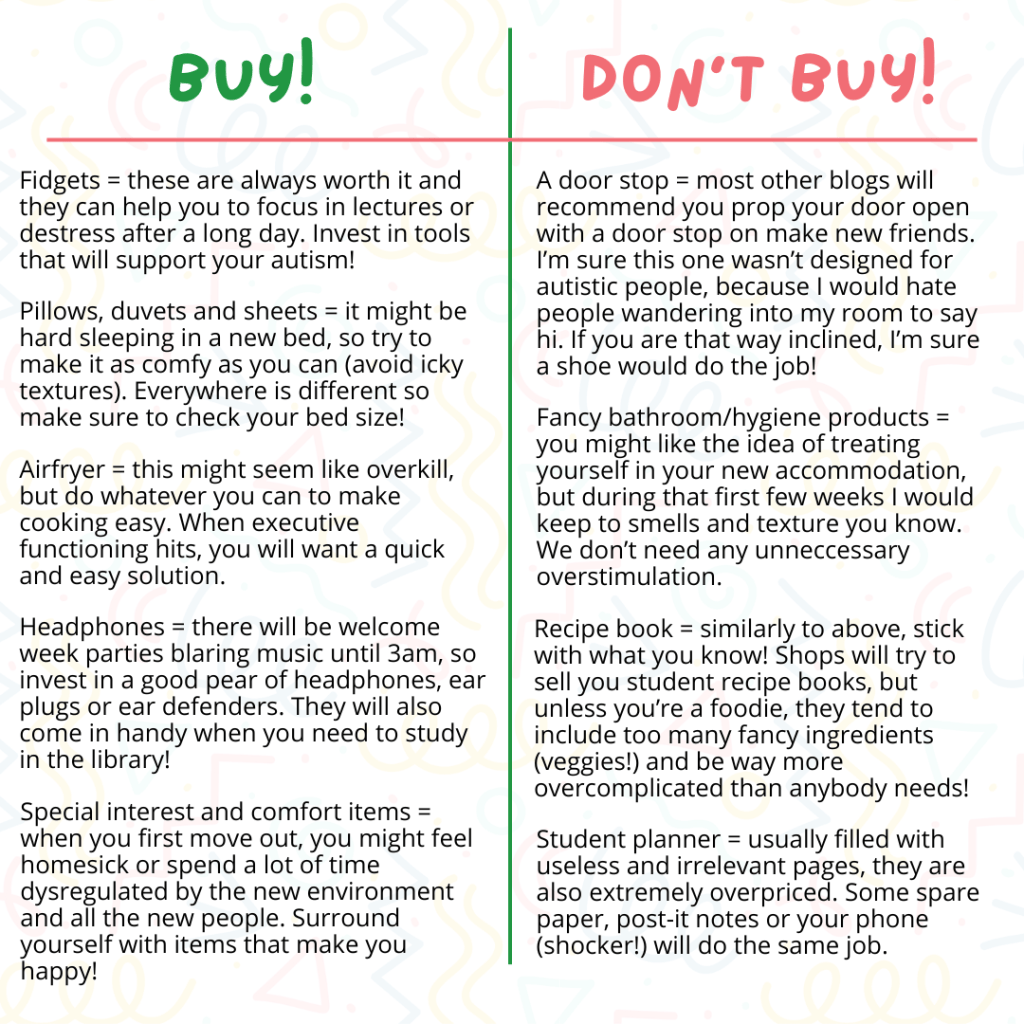
Another top tip would be to get your shopping done early. If you wait until September, IKEA will have been ransacked by fellow students, and shopping is overstimulating enough without that added chaos.
So, how are you feeling now that it’s time for you to move in? Can you tell if the butterflies in your tummy are nerves or excitement? Or a mixture of both? Coming up, I will post my part two of this blog, where I talk about ‘the big day.’ After exploring the logistics and preparation for student accommodation, I will go on to talk about some of the emotional challenges of it all, and how I coped with my autism and mental health over the first few weeks of living away from home, as well as seeing how some of my autistic friends felt about it all.


 I am autistic